
Dr. Robyn Roberts
Field Crops Pathologist and CSU Assistant Professor
970-491-8239
*Email is the best way to reach me
June 1, 2026
Summary:
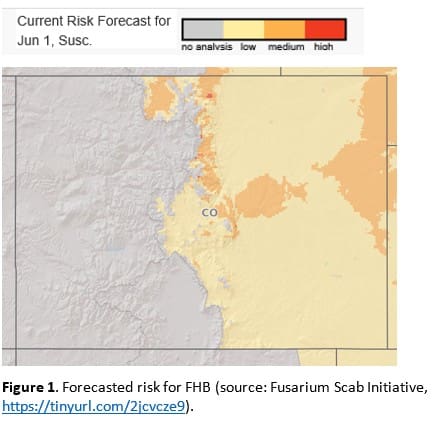
- Some areas have a moderate to high risk for Fusarium head blight/head scab.
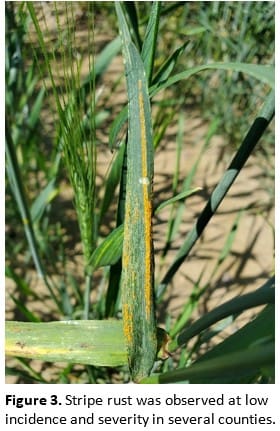
- Stripe rust was reported at low levels in Washington county.
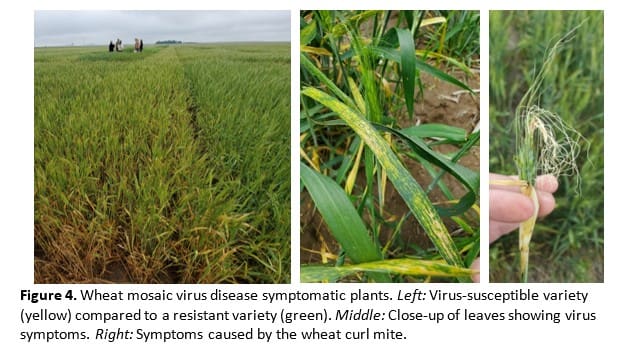
- Viruses continue to be a problem.
Disease Observations and Management
Fusarium head blight (head scab)
Some areas across Colorado have a moderate to high risk of developing Fusarium head blight (FHB), also called ‘scab’ (Figure 1). Symptoms appear as white heads or spikelets on otherwise green plants (Figure 2). The fungus may be visible within the white heads as pink strings. The fungal pathogen requires wet conditions, so FHB is more common after significant, prolonged rainfall. The fungus infects flowers, and the timing of wet, warm weather with flowering provides optimal conditions for disease development.
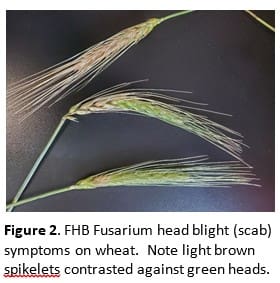
The pathogen also produces a mycotoxin called deoxynivalenol (DON), which is a toxic chemical to people and livestock. Elevated levels of mycotoxin can accumulate even under minor disease conditions, and high numbers of damaged, wrinkled, or ‘tombstone’ grains can indicate high levels of mycotoxin. The spores produced from the initial infection can produce additional spores that infect other heads. Significant disease problems can therefore occur if wheat stands are uneven with late flowering tillers.
Management and Prevention:
Infected corn or wheat residue can be a significant source of inoculum. In addition to genetic resistance, managing residue and applying a fungicide that is labeled for FHB at early wheat flowering are the best control methods when the pressure is moderate or severe. However, in many cases it is too late to apply a fungicide due to the ~30-35 day pre-harvest interval for most labeled fungicides. Penn State University and colleagues at the Fusarium Scab Initiative have developed a risk assessment tool to predict the likelihood of FHB: https://tinyurl.com/2jcvcze9.
Stripe Rust
Stripe rust was observed at low levels in Washington county (Figure 3). Cool, wet weather has been conducive to disease development, but the stripe rust inoculum levels, as well as incidence and severity, remain low.
Management and Prevention: In most cases, it is too close to harvest to apply a fungicide- most require a pre-harvest interval of 30 days or more. Yield is most impacted at the flag leaf stage, so stripe rust should not be a major yield determinant at the observed low levels.
Mosaic virus complex
Viruses continue to be the major disease problem this year, with many reports of symptomatic fields across Colorado, including mosaic patterns and yellow streaks (Figure 4). The wheat mosaic virus complex is caused by one or more viruses, including Triticum mosaic virus (TriMV), wheat streak mosaic virus (WSMV), and/or high plains wheat mosaic virus (HPWMoV). It is transmitted by the wheat curl mite, which may cause ‘curling’ symptoms on their own.
Management and prevention: There is no treatment for the disease, and no miticides are effective against the vector (the wheat curl mite). Controlling volunteer wheat and planting mite- and virus- resistant varieties are the best control measures. To prevent viruses next year, volunteer wheat should be eliminated between harvest and planting, both in fields and surrounding areas, and be killed for at least 2 weeks before planting. Volunteer corn and other grasses can also harbor the mites, so general weed control is also essential.
Cereal yellow dwarf virus
Cereal yellow dwarf virus(CYDV) symptoms were observed in Kiowa county. CYDV is transmitted by aphids, and symptoms include plant stunting and yellowing of the leaves (Figure 5). Unlike the other common wheat viruses, BYDV and CYDV do not display any mosaic patterns. Typically, CYDV is rare in Colorado (last report by my lab group was in 2021).
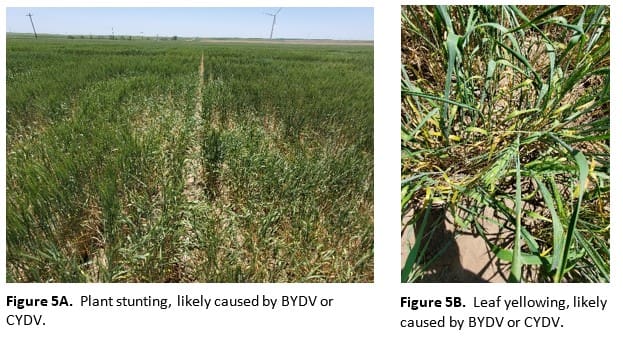
Management and prevention: In most cases, it is too late to apply pesticides to protect Colorado wheat from the aphid vector because of pre-harvest interval (PHI) limitations. Outside PHI limits, pesticides are recommended only if you observe a high incidence of aphids in your fields that is above the economic threshold.
Additional resources
- Fusarium risk tool: https://www.wheatscab.psu.edu/?ct=YTo1OntzOjY6InNvdXJjZSI7YToyOntpOjA7czo1OiJlbWFpbCI7aToxO2k6NjM7fXM6NToiZW1haWwiO2k6NjM7czo0OiJzdGF0IjtzOjIyOiI2NjA1OWYxMzk5MmJjMzY4ODcyMDIyIjtzOjQ6ImxlYWQiO3M6MjoiMjAiO3M6NzoiY2hhbm5lbCI7YToxOntzOjU6ImVtYWlsIjtpOjYzO319
- Fungicide Efficacy for Control of Wheat Diseases: https://cropprotectionnetwork.org/publications/fungicide-efficacy-for-control-of-wheat-diseases
Contributors: Many thanks to Sally Jones-Diamond, Tyler Benninghoven, Dr. Emily Luna, and Dr. Esten Mason who contributed to this report.