
Adam Osterholzer: adam.osterholzer@colostate.edu, 970-222-9568
Dr. Punya Nachappa: Punya.Nachappa@colostate.edu, 785-383-4873
Visit our website at: https://www.csuwheatentomology.com/
Wheat Stem Sawfly Adult Flight in New Raymer
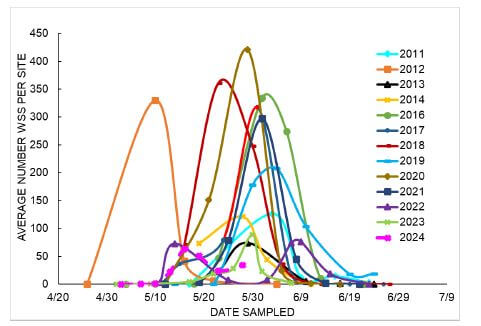
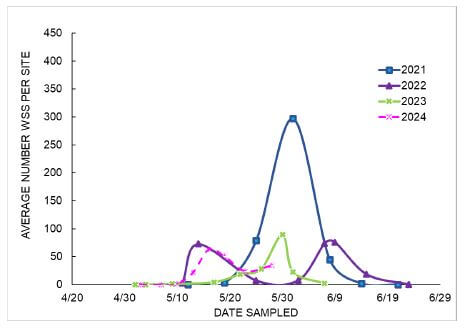
We have continued our survey for adult sawflies twice per week at 7 sites in New Raymer and 3 sites in Orchard. The graph depicting adult population over the 13-year period is on the top panel and the graph depicting the last 4 years is on the bottom panel (for easy readability). Overall, the population counts are lower than past years such as 2021 but the counts are similar to 2022 and 2023. In 2024, the average number of sawflies per site was 32. The adult population peak was estimated at 241 degree-days according to our phenology model, which was May 24th in New Raymer, so we believe that the population is now in decline in New Raymer. We did not observe any sawflies in Orchard.
The last 3 years have had low populations in New Raymer, which has been a hotspot for sawflies. Jim Mertens and Cary Wickstrom also confirmed the low sawfly populations this year. Several factors might be responsible for this, namely growing semi-solid wheat varieties and the weather. Indeed, a study from Canada showed that sawfly populations restricted to the solid-stemmed cultivar ‘Rescue’ declined over a 5-year period to almost zero (Holmes and Peterson 1957). We also observed higher ratio of male wasps to female wasps. The emergence of sawflies in New Raymer coincided with cool and wet weather with high winds (greater than 12 mph) which may also be responsible for low populations. However, Sally Jones-Diamond reports high sawfly activity in Hoyt/Prospect Valley and sawflies were confirmed at Akron and Yuma.
While the adult counts in New Raymer may be low, this is not reflective about the state-wide infestation levels. For example, 2022 had one of the worst sawfly infestation state-wide but the adult counts in New Raymer were low. We will begin our state-wide survey of sawfly larval infestations soon, which should tell us about the extent of sawfly infestation in the state.
New Grass Sawfly
Last year, we found caterpillars of a new sawfly species, grass sawfly feeding on wheat in New Raymer so this year we have been monitoring them to study their biology and life cycle. We are rearing the caterpillars in our greenhouse and they seem to feed on both leaves and wheat heads, but so far they don’t appear to cause significant damage to the plants.

Wheat Field Days
We are looking forward to meeting you all the Wheat field days! We have written two articles about wheat stem sawfly in the CSU Crop Testing Making Better Decisions: Colorado Wheat Variety Trials 2024 Technical Report.
Wheat Diseases
For wheat disease updates by Dr. Robyn Roberts, please see: https://coloradowheat.org/category/news-events/wheat-pest-and-disease-update/
Acknowledgments
We would like to acknowledge the tireless work of CSU researchers and extension agents for reporting pest problems throughout the state. Special thanks to Jim Mertens, Cary Wickstrom, Kevin Larson, Brett Pettinger, Ron Meyer, Todd Ballard, Sally Jones-Diamond, Dennis Kaan, Kat Caswell, and Michaela Mattes.
Paper Cited
Holmes, N.D., and Peterson, L.K. 1957. Effect of continuous rearing in Rescue wheat on the survival of the wheat stem sawfly Cephus cinctus Nort. (Hymenoptera: Cephidae). The Canadian Entomologist, 89: 363–364. doi:10.4039/Ent89363-8.